|
Schutzhund
The literal translation from
German to English of the word "Schutzhund" (protection dog) is really quite
misleading. To help acquaint you with this complicated, three level, three phase
dog sport, following you will find a simple and condensed explanation of
Schutzhund rules, regulations, and the point system used.
Schutzhund originated in Germany
as a test for the German Shepherd Dog (GSD) so that breeders could evaluate and
pick only the highest quality dogs for their breeding programs. Even today, no
German Shepherd or Rottweiler can be bred in Germany without a ZTP, which
involves portions of the protection and obedience of Schutzhund
Schutzhund Titles
Schutzhund offers three levels
of titles, and there are three phases to each title. One must obtain a passing
score in all three phases in order to obtain a title, and be able to advance to
the next training level.
The titles are:
-
Sch H I (novice)
-
Sch H II (intermediate)
-
Sch H III (master level)
There is also an advanced
tracking degree offered, FH.
The sport is designated for all
athletic dogs with correct working abilities and is not restricted to a
particular group or breed of dog. Schutzhund is now the fasted growing Dog Sport
in North America!
Schutzhund Training Phases
For each of the three titles
already discussed above, there are three distinct phases: tracking, obedience,
and protection.
Tracking
In this phase, the dog must draw
from inherited abilities by using his/her nose to find a person's track and
discover articles that have been dropped along the way. Depending upon the title
sought, all tracks will vary in length, shape and age. Tracking is usually done
in dirt or on grass. A perfect score is 100 points, with a minimum of 70 needed
to pass.
Obedience
The obedience phase involves
numerous and demanding exercises which include heeling on and off leash, a
gunfire test, walking through a group of people, motion exercises, recall, a
10-20 minute long down, retrieving, and jumping. A set pattern is demonstrated
by the handler from memory (unlike AKC obedience, where the judge calls the
pattern for you). A perfect score is 100 points, with 70 needed to pass.
Protection
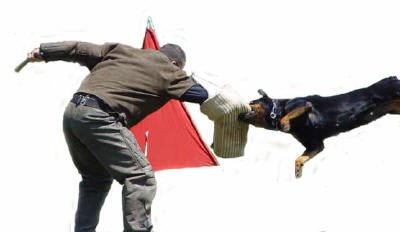
This phase of Schutzhund
training is very intricate, advanced, and taught with control in mind. It should
not be confused or compared in any way with guard dog or police protection
training. A dog competing in the sport of Schutzhund must always prove to have a
reliable temperament and must show courage without viciousness. The "bad guy" or
"helper" as he is known in the sport always wears protective leather pants and a
special sleeve with a burlap cover. The dog is allowed to bite this sleeve and
he must bite this in the correct manner. On command, the dog MUST release the
bite.
A dog will fail if it does not release the bite when commanded to do so.
A perfect score is 100 points, with 80 points needed to pass.
Many people view the sport of
Schutzhund like preparing for an Olympic Event. One must see their dog as an
athlete and learn all the aspects of conditioning, proper diet, and the
psychology of it all -- for one's self as well as for the dog.
Additional Dog Training Links
Rules as defined by the
United Schutzhund Clubs of America
Preface
This document is a translation
of various rules for the conduct of working dog examinations as used in Germany.
These rules have been adopted for use by the United Schutzhund Clubs of America
with certain amendments and variances. This document and any approved amendments
and shall be the official rule book for the conduct of all working dog
evaluation events sanctioned by the United Schutzhund Clubs of America.
Unauthorized duplication is strictly forbidden. Copies of this publication can
be obtained by contacting the USA business office at United Schutzhund Clubs of
America, 3810 Paule Ave, St. Louis, Mo 63125-1718, (314)638-9686.
Back
to top
USA Variances
from the Following Rules:
The United Schutzhund Clubs
of America has requested and received variances form the following rules in some
instances. The Board of Directors of USA has also adopted variances of its own
accord. The following variances to the preceding rules in effect for all USA
trials
1. The waiting period between
trials has been reduced from four to two weeks.
2. The limit on the number of
dogs to be judged by one judge in one day
in a Schutzhund trial has been increased from 10 to 12 dogs.
3. All dogs entered in a USA
sanctioned trial must pass a test of impartiality.
4. Restrictions limiting
participation by physically impaired handlers do
not apply to USA trials and shows.
Back
to top
General Rules
and Regulations
Part A. DEGREE LEVELS
Schutzhund Examination A
SchH A
Begleithunde Examination B
Schutzhund Examination I Schl-l I
Schutzhund Examination Il SchH II
Schutzhund Examination III SchH III
Part B. REQUIREMENTS
The minimum age requirements
for entry into the various degree levels are:
SchH A
18 months
SchH 1 18 months
Schl-l 11 19 months
Schl-l 111 20 months
FH
16 months
B
12 months
Evidence of prior achievement
of the B title must be presented before entry into SchHI is permitted.
On any given day when one
judge is officiating, a maximum of 10 (12 In USA) dogs may be entered in a
trial. If the entries exceed this figure, the trial must be extended to another
day or other judges must be secured to officiate.
Dogs are only allowed to be
exhibited in one Schutzhund degree per scheduled trial. If a dog has been
awarded a degree, a four week (two weeks in USA) waiting period must elapse
before the dog can be exhibited for the next higher degree. Once a dog has
earned a SchH III degree, it is up to the discretion of the handier when he/she
wishes to exhibit the dog again. Dogs exhibited in a lower degree examination
than actually earned by the dog shall be awarded rankings behind those who
earned their degree at the scheduled trial. (This is for awards, trophies,
placings, etc.) It is up to the discretion of the handier to repeat a Schutzhund
degree without being bound by the waiting period, but not at the same scheduled
trial date. It is also not permissible for a handier to participate in two
trials on the same day.
Only dogs that appear healthy
can be exhibited in a trial. Before being permitted to participate in a trial,
each dog must pass a test of impartiality and sureness. The testing of the self
confidence will take place during the entire trial. Dogs who fail the test of
self confidence or impartiality are to be excused from the trial proceedings. A
dog is to be dismissed from the trial, if it demonstrates faulty temperament
during the trial even though the initial test for impartiality was positive.
PART C. POINT SCORE AND RATINGS
The highest maximum score in
each phase shall be 100 points and therefore the highest point score in all
three phases shall be 300 points. A degree can only be awarded if a dog achieves
at least 70 points in phases A (tracking) and B (obedience) and at least 80
points in phase C (protection). The following ratings shall be awarded with the
corresponding point totals:
Unsatisfactory 0
- 109 points
Insufficient 110 - 219 points
Satisfactory 220 - 239 points
Good
240 - 269 points
Very Good 270 - 285 points
Excellent 286
- 300 points
Should there be awards
presented and in the case of a tie, the dog with the highest point score in
phase C should receive the award. Should there still be a tie, the point score
in phase B shall prevail.
For a SchH A, the highest
possible point score is 200 points. The pass-score in this degree is a minimum
of 70 points in phase B and a mini- of 80 points in phase C. The following
ratings shall be awarded with the corresponding point totals:
Unsatisfactory 0
- 72 points
Insufficient 73 - 149 points
Satisfactory 150 - 159 points
Good
160 - 179 points
Very Good 180 - 190 points
Excellent 191
- 200 points
Awards for combativeness
including courage and hardness are:
P -- Pronounced (Ausgepraegt)
S -- Satisfactory (Vorhanden)
I -- Insufficient (Nicht Genugend)
PART D. THE CONDUCT OF THE
PARTICIPANTS
At the beginning of each
trial after being summoned by name, each handler and dog shall report to the
judge repeating the handlers as well as the dog's name. The dog must be leashed
(unleashed in SchH 111) and is to sit in the basic heel position. The pedigree
and registration certificate as well as the scorebook is to be presented to the
trial secretary prior to the trial (scorebook only in USA). Should the hosting
organization demand a membership or affiliation requirement, then a valid
member-ship card must be presented.
Evidence of the prior
achievement of a SchH I must be presented before entry into the FH is permitted.
Dogs who do not possess the SchH before entry into the FH is permitted to enter
for the FH provided they have attained the degree B (Companion Dog). In this
case, the awarded title shall have no bearing in regards to breed show or breed
survey rules and regulations.
Each participant must follow
the instructions of the judge as well as those of the trial committee without
any disagreement. The handler must exhibit the dog in a sporty and faultless
manner. Ill-natured actions or Poor sportsmanship will lead to expulsion from
the trial. The final decision in all cases rests with the presiding judge and
the decision of the judge is unchallengeable. A protest is not permitted. In the
event anyone is expelled from a trial by the judge or trial secretary, the USA
Board of Inquiry will review the situation for further possible disciplinary
action.
During the trial, the dog
must be exhibited with a choke collar in the neutral position (dead ring).
Leather and spike collars are not permitted. The handler may praise the dog only
once after each exercise. Body help from the handler is not permitted and if
used will be penalized by point deductions.
Handlers that possess
physical handicaps that hinder movement of the dog on the left side of the
handler can show dogs on the handler's right side. In such cases, the dog and
handler will be judged without pre- as long as the performance is analogous to a
left heeling dog.
PART E. DUTIES OF THE TRIAL
SECRETARY
Before the start of the
trial, the trial secretary must inform and show proof to the judge that the
necessary permission was attained by the club for the examination The judge will
be presented with properly filled out judge's books.
The trial secretary is
responsible for securing suitable tracking flelds and that sufficient
experienced track layers are available. A sport field sufficiently large for
both obedience and protection phases must be available. The secretary is also
responsible for providing the necessary one or two experienced helpers with
proper protective equipment. 'Me secretary will also assure that all needed
equipment is provided and that a group of at least four people is available when
needed.
The trial secretary must
assure that a proper, orderly completion of the trial is attained. The trial
secretary must be at the disposal of the judge at all times. The trial secretary
must provide a sufficient number of score sheets and judge's books and make
certain they are all properly prepared and completed.
Back
to top
Schutzhund I Tracking
|
Trial Level |
Tracklayer |
Approx Length
(paces) |
Age in Minutes |
Crosstrack
Laid |
|
SchH A |
----- |
----- |
----- |
----- |
|
SchH 1 |
Handler |
350 - 400 |
20 |
----- |
|
SchH 2 |
Stranger |
600 |
30 |
----- |
|
SchH 3 |
Stranger |
800 |
60 |
----- |
|
FH 1 |
Stranger |
1000 - 1400 |
180 |
After 30 min |
|
FH 2 |
Stranger |
2000 |
180 |
30 min
before start |
|
|
Trial
Level |
# of
legs |
# of
corners |
# of
articles |
Parts per
Article |
Voice
Command |
Further
Requirements |
|
SchH A |
----- |
----- |
----- |
----- |
----- |
----- |
|
SchH 1 |
3 |
2 |
2 |
10-10 |
“Such” |
Change of
terrain possible |
|
SchH 2 |
3 |
2 |
2 |
10-10 |
“Such” |
Change of
terrain possible |
|
SchH 3 |
5 |
4 |
3 |
7-7-6 |
“Such” |
Change of
terrain possible |
|
FH 1 |
7 |
6 |
4 |
5-5-5-5 |
“Such” |
Terrain change,
path/road, & X-track=required |
|
FH 2 |
8 |
7 |
7 |
6 x 3
1 x 2 |
“Such” |
As in FH 1 |
|
No FH may be laid on a solid
snow-cover.
30 minutes after the laying
of the FH 1 track, and 30 minutes before starting the dog on the FH 2 track, a
second person (who is also a stranger to the dog) will receive a signal from the
judge to lay the cross-track, which shall cross the track three times.
Point Allocation in the
Tracking Work:
|
Trial Level |
Start & 1. leg |
1. corner & 2. leg |
2. corner & 3. leg |
3. corner & 4. leg |
4. corner & 5. leg |
5. corner & 6. leg |
6. corner & 7. leg |
7. corner & 8. leg |
Article Points |
|
SchH 1 |
27 |
27 |
----- |
----- |
----- |
----- |
----- |
----- |
10/10 |
|
SchH2 |
27 |
27 |
----- |
----- |
----- |
----- |
----- |
----- |
10/10 |
|
SchH3 |
16 |
16 |
16 |
16 |
16 |
----- |
----- |
----- |
7/7/6 |
|
FH 1 |
12 |
12 |
12 |
11 |
11 |
11 |
11 |
----- |
5/5/5/5 |
|
FH 2 |
10 |
10 |
10 |
10 |
10 |
10 |
10 |
10 |
6 x 3
1 x 2 |
|
1. Suitable Terrain for
Tracking:
Meadow grass, plowed fields
and forest soil: All natural terrains. Sight-tracking is to be avoided as much
as possible.
2. Tracking Articles:
Within any one track,
articles different from each other must be used. Their color may not stand out
considerably from that of the terrain, and their size may not exceed that of a
wallet (billfold).
Materials: Leather, vinyl,
fabric, wood.
In SchH 2, 3 and FH the
articles are to be given to the track layer(s) far enough in advance so that the
track layer(s) can carry the articles on their bodies for at least 30 minutes
before laying the tracks.
In SchH 1, the handler uses
his/her own articles. Attention should be paid to see that these articles are
likewise well-scented.
B: THE LAYING OF THE TRACK:
Before laying the SchH 1
track, the handler must show the articles to the judge. Only the previously
described "common-use/household" articles are to be used. The trial judge is
responsible for determining the layout of the tracks, and for the instruction of
the track layer(s).
The handlers may not be
present during the laying of the tracks for SchH 2, 3 and FH. During the laying
of the SchH 1 track the dog must remain out of sight.
1. The Starting-Place:
The starting-place is to be
marked with a signpost (tracking stake with number mark). It is to be placed in
the ground directly to the left of the starting-point, and must remain there
throughout the tracking work.
The track layer remains for
awhile on the starting-place, and light stepping about on it is permitted.
The track layer then
proceeds at a normal pace in the direction prescribed by the judge. Scraping of
feet or interruption in pace is not permitted.
After laying the last article, the track layer must proceed a few paces further
straight ahead.
2. The Legs of the Track:
The number of
track-legs is prescribed in the relevant Trial Level section of the Trial Rules.
3. The Corners:
The corners (about 90)
are likewise to be made at a normal pace, during which attention must be paid to
make sure that it is possible for the dog to continue tracking directly into the
next leg of the track. The continuity of the track is not to be
destroyed/disrupted by the making of the corners. Heavy stomping of the corners
is not allowed.
4. The Placing of the Articles:
The articles are to be laid
on the track, while the track layer is in motion. After laying the last article
at the end of the track, the track layer must proceed straight ahead a few paces
further.
SchH 1: Article #1 is
laid in the middle of either the first or the second leg (handler's choice as to
which leg); article #2 at the end of the track.
SchH 2: Article #1 is laid in the middle of the second leg; article #2 at the
end of the track.
SchH 3: Article #1 is laid at least 100 paces out (and possibly on the second
leg); article #2 at approximately middle of second or third leg of track;
article #3 at end of track.
FH 1: Article #1 is laid at least 250 paces out (on 1 st or 2nd leg); articles
#2 and #3 are laid on the judge's signal; article #4 at end of the track.
FH 2: The placement of article is determined by the judge.
C: VARIOUS OPTIONS IN THE TRACKING WORK:
The following handling
options are permitted in the working out of the track: a) Collar b) Tracking
harness c) Free tracking
a) The collar:
The collar may not be used on the choke-ring. The lead (attached to the collar)
may be placed over the dog's back, along the side of the dog, or between the
fore-legs and/or the hindlegs.
b) The tracking harness
The following types of tracking harness are permitted: The breastharness, and
the Bottger-tracking harness.
The tracking line is to be attached to the tracking harness by means of the
device (ring, etc.) on the harness that is provided for that purpose, without
attaching the line to the collar (except in the case of a 136ttger-harness).
If a Bottger harness is used, the judge must ensure that the bodystrap is not
fastened in the area of the dog's sensitive (private) parts.
The use of additional straps is not permitted.
The tracking line must be at least ten meters long. Examination of the line
length, the collar and the harness by the judge may take place before the
beginning of the trial. Retractable lines are not permiffed.
c) Free tracking
The distance of at least 10 meters between handler and dog must be maintained.
D: WORKING OUT OF THE TRACK/EVALUATION OF
THE TRACKING WORK:
After the tracks are laid for SchH 2, 3
and FH, the judge or the trial chairperson will have the handlers draw for their
starting positions.
Each handler will report in, in the basic position, with his/her dog ready for
tracking, on the laid-out tracking line.
The handler will inform the judge whether the dog will indicate or pick up the
articles.
The Start:
The dog is to be brought calmly to the starting point; any forceful influence is
to be avoided here.
The setting of the dog onto the track, at the start and after finding the
articles, must be done at the dog's location (not from a distance). A certain
amount of play in the line must be available to the handler.
The dog is to take the scent at the start calmly and intensively. The taking of
the scent must occur without help from the handler (except for the voice command
"Such"/"Seek"). The start is not time-dependent.
After successfully taking up the scent, the dog must proceed with tracking
behavior appropriate to the working out of the track.
After the 4th unsuccessful start at the beginning, the tracking work is to be
terminated.
Exception: The FH rules state that within the first 15 paces after the start,
the dog may be restarted only once (subject to deduction of up to 4 points).
Once the dog has taken up the scent and is following it, the handler must remain
at the starting point until the dog has reached the end of the tracking line, or
until the required distance of 10 meters is reached. Earlier following of the
dog is faulty.
Re-starting of the dog further on in the course of the track is not permitted in
any trial level.
A restart consists of the handler taking the dog at heel, by the collar or on a
shortened line, and again setting the dog onto the track. Tracking Performance:
The dog is to follow the course of the track evenly and intensively with a deep
nose. Whether the dog tracks fast or slowly is not a factor in the scoring, so
long as the track is worked out intensively, evenly and convincingly.
The tracking line may sag, but this may not result in a substantial shortening
of the distance between handler and dog. The line touching the ground is not
faulty.
Corners:
The corners are to be worked out closely and confidently. A dog's checking at
the corner, to convince himself of the lay of the track, is not faulty so long
as he does not leave the track. Close circling at the corner is definitely
faulty. After working out the corner, the dog must continue tracking at his
regular pace.
Indicating and Picking Up of Articles:
Indicating of articles must be done convincingly, in the direction of the track,
and right before the article. Minor crookedness of position is not faulty, but
sideways indicating of the article or strong turning around toward the handler
is faulty. Articles which are indicated or picked up with strong handler-help
are counted as not found.
The indicating of articles may be done standing, sifting, lying down, or by
alternating these positions.
Indicating and picking up is faulty.
If the dog picks up articles, he may then stand still, sit, or come to the
handler. Moving forward with the picked-up article or picking it up while lying
down is faulty. If the dog brings the article to the handler, the handler may
not move toward the dog.
As soon as the dog has found an article, he must immediately pick it up or
indicate it convincingly, without influence from the handler. The handler must
drop the line and immediately go to the dog. Found articles are to be shown to
the judge by holding them in the hand and raising the arm up high.
The handler must position himself next to the dog while taking delivery of or
lifting up of the article.
The dog must remain calmly in the indicating or picking-up position until his
handler, standing beside him, restarts him with a short line.
If the dog indicates a false object or interrupts his tracking-work (i.e. by
lying down, sitting or standing still), this is faulty and will cause
point-deduction.
If, on command from the handler, the dog continues to work at the 10-meter
distance, only 2 points will be deducted, and it will not be counted as a false
indication. If the handler goes to the dog, it will be counted as a false
indication and penalized by a 4-point deduction.
Leaving the Track:
If the dog goes to leave the track and the handler restrains him from doing so,
the judge will instruct the handler to follow the dog. The handler must obey
this instruction. The tracking-work is to be terminated if the dog leaves the
track by more than one line-length (or by more than 10 meters if the dog is
free-tracking), or if the handler fails to obey the judge's instruction to
follow the dog.
FH cross-track:
The dog may follow the cross-track for up to one line-length (with point loss).
The tracking will be terminated if the dog leaves the track by more than one
line-length (10 meters if free-tracking).
Wild Game:
If wild game appears during the tracking-work and the dog goes into hunting
drive, the handler may give the "Platz" ("Down") command in an effort to bring
the dog into obedience. On the judge's signal, the tracking-work will then
continue. If this is unsuccessful, the tracking-work is to be terminated.
Praise:
Occasional praise and giving of the command "Such" ("Seek") is permitted in all
trial levels.
Reporting-Out:
After completion of the tracking-work, the found articles are to be shown to the
judge. It is not permitted to play with or feed the dog between the finding of
the last article and the reporting-out procedure.
Reporting-out must be done with the dog in the basic position. Scoring of
Tracking Work:
Faulty starting, aimless wandering, frequent circling on the corners, continuous
encouragement, incorrect picking up or indicating, and dropping of articles will
be penalized up to 4 points.
Repeated starting, strong wandering, tracking with a predominantly high nose,
hectic tracking, urinating/ defecating, mouse-catching etc. are penalized up to
8 points.
For articles not found, the prescribed article-points will not be given.
E: TRACKING DOG - LEVEL 2 (FH 2):
1. General:
It is pointed out that Tracking Dog Level 2 (FH 2) represents a type of test
which is essentially to be undertaken by sport (civilian) dogs. Special claims
(pretenses) which might arise out of the realm of service dog achievements are
not to be made.
It is mandatory that the track laying for this test be performed by responsible
persons who have undergone a special training (schooling) in the field.
As a rule, the trial judge for this type of test may not accompany the track
layer, tracking-diagrams must be drawn by the track layer. The judge must also
make sure that the cross-tracks are laid according to the rules Y2 hour before
the starttime.
2. Entry Requirements:
It is prerequisite to the taking of this test, that the dog be at least 20
months old and have earned an FH 1 title. Also eligible to enter the FH 2 test
are dogs which, prior to their earning the FH 1 title, did not have a SchH 1
title but instead had passed a BH test. In this case, an FH 2 title earned will
not constitute a "training title" that meets the requirements of any breeding,
showing or K6rung (breed-survey) regulations of a breed-club.
3. Performance in the Tracking Work
Maximum score: 100 points (Voice command: "Such"/"Seek")
-Working of the track = 80 pts -7 articles (6x3,1x2) = 20 pts
The dog must demonstrate his track-sureness on a stranger's track that is at
least three hours old and at least 2000 paces long, with seven angles
("corners") that conform to the terrain. At least two of the angles must be
acute and one must be an arc (segment of a circle). The track will be crossed at
least twice by a fresher stranger-track, at varying points separate from each
other.
Along the track, at irregular distances, will be placed seven articles that have
been well-scented by the track- layer. The article measurements (maximum) will
be: length 10 cm (4"), width 3 cm (1.2"), thickness 1 cm (0.4"). So-called "searchpackets"
are not permitted. The articles are to be found by the dog and either indicated
or picked up.
Before the start of the track, the handler must report to the judge whether the
dog picks up or indicates articles. Doing both together (picking up and
indicating), or doing both on the same track, is faulty.
The handler may, at his/her option, track the dog free or on a tracking line.
The tracking line may hang loose, so long as the handler does not let it out of
his/her hand.
4. Laying of the Track:
The track layer, who is a stranger to the dog, must prepare a terrain-sketch for
the judge. The course of the track is to be planned in advance with the judge or
with the appointed tracking chairperson, utilizing natural landmarks such as
lonestanding trees, power poles, shed s/cottages/outbuildings etc.
Before laying the track, the track layer will show the required tracking
articles to the judge/tracking chairperson. The track layer must have carried
the articles on his person for at least 30 minutes, in order to scent them well.
The articles may not exceed the above-stated dimensions, and they must not
differ markedly in their color from the surrounding terrain.
The start of the track is located within a surface area of 20 x 20 meters, in
which only the track layer has entered. Entry into this area by any third party
is to be prevented. The track layer will place in the ground, 20 paces apart,
two markingstakes, between which is the "starting-line". From either the
starting-line or from one of the two stakes, the track layer goes out and lays
down an "identification article". This article marks the true start of the
track. The "identification article" is of a similar size and composition as the
other articles on the track, but it is not counted in the scoring.
Once the track layer has laid down the "identification article", he must remain
standing on that spot for a brief period of time. The track will then be laid at
a normal pace.
The articles are to be laid on the track at irregular distances. The first
article must be placed at least 250 paces from the starting-point. The seventh
(last) article is laid at the end of the track. Articles must not be laid at
corners (angles) or in the immediate vicinity thereof. They must not be laid
next to the track, but actually an the track. The track layer will indicate on
his track-diagram, by placing "X" marks, all of the places where he has laid the
articles. Careful attention is to be given to ensure that the track is laid over
changing terrain. It must be laid so as to simulate a real situation, therefore
any "pre-drawn map or pattern" is to be avoided.
Thirty minutes before the start-time, a second track layer (also a stranger to
the dog), by arrangement with and under direction from the primary track layer,
will receive the instruction to lay a cross-track that will intersect the
primary track at least twice.
5. Working of the Track:
The "start-line" marked by the track layer will be made known to the handler by
the judge. But the "start-line" itself does not necessarily establish the
direction of the first leg of the track. From the location of the
"identification article", the track may proceed straight ahead, right, left or
even at an angle. Notice should be taken of the fact that the first leg of the
track may not cross the "start-line."
For the searching-out of the "identification article", the handler is free to
handle the dog either off-lead or on the tracking line. The time allotted for
the dog to locate the "identification article" (= the start-point), determine
the direction of the track, and begin working out the track is limited to three
minutes. The handler is free to choose the point on the "start-line" at which he
will start the dog searching for the "identification article."
The handler may not cross over the "starting-line" until the 10-meter tracking
line has run out (or the free-working dog has reached a distance of 10 meters
away from the handler). The handler may encourage the dog, during the search for
the "identification article", by means of voice and/or hand signals.
If the dog comes onto the track beyond the "identification article" and takes up
the tracking-work confidently, the handler must follow the dog. In this case,
the tracking work must continue on in the same way the dog began (free or on the
tracking line). If the dog finds the "identification article", the handler goes
immediately to him and starts him on the working-out of the track. He may first,
if necessary, attach a tracking line to the collar or harness.
The dog should be allowed to take up the scent thoroughly at the starting-point.
He should be so trained that with no influence from the handler he will calmly
and extensively take the scent at the starting-point. Under no circumstances may
the handler, with his hand, arouse in the dog the urge to charge ahead forwards.
No restarting is permitted.
As soon as the dog begins to track, the handier must stand still and let the
10-meter tracking line glide through his hands. The tracking line, attached
either to the collar or to a harness, may be placed over the dog's back, along
the dog's side, or between the dog's front and/or hind legs.
The track should be worked out calmly, so that the handler can follow at a
normal pace. The handler follows at about a 10-meter distance, which must also
be maintained if the dog is tracking free. When the dog comes upon an article,
he must immediately pick it up or indicate it convincingly. When picking it up
the dog may stand still, sit or come to the handier. If he comes to the handier,
the handler may not advance toward him. Proceeding forward with the picked-up
article is faulty. Indicating may be done sifting, lying down, standing, or
alternating among those positions.
The handler must go to the
dog immediately and take the article after raising it in the air to show the
judge. The handler praises the dog and immediately lets himcontinue tracking. If
the dog, while on the track, comes upon an article that was not placed by the
track layer, he may neither pick it up or indicate it. If the dog changes over
from the primary track onto the cross-track and follows it for more than one
line-length, the tracking-work must be terminated. The judge is permitted to
give the handier some positional help whenever the terrain imposes extreme
difficulties which the dog cannot overcome (for example large water holes or
deep gulleys/trenches, etc.). No points are deducted for this.
The handler is allowed, after consultation with the judge, to interrupt the
trackingwork briefly if he believes that he or his dog needs a short pause, on
grounds of physical (health) status or weather conditions (i.e. extreme heat).
Here also there is no point deduction. The restarting of the dog on the track
will not be scored as a "restart" under the meaning prescribed as faulty in the
Trial Rulebook. The time taken for such permitted pauses, how-ever, is counted
in the total time available to the handler and dog for working out the track.
The handler is allowed, during -a "pause" or at an article, to clean up the
dog's head, eyes and nose. For this purpose, he may carry with him during the
tracking work a wet cloth or sponge. These items are to be shown to the judge
before the start of the tracking-work. Further aids are not permitted.
Any physical help (i.e. jerking on the line) or meaningful verbal help
(additional commands to track) are to be refrained from by the handier. If any
such help is given, it could lead to termination of the tracking-work.
Scoring:
The maximum 100 points can only be given when a dog works out his track from
beginning to end, at a walking pace throughout, and picks up or indicates all
seven articles.
All the angles ("corners")
must be worked out confidently. The dog may not let himself be influenced by the
cross-tracks. Among the first six articles, every one not found will cost 3
points, and the last article if not found will cost 2 points. Picking up in
combination or alternation with indicating is faulty. For a falsely picked up or
indicated article, 1.5 points will be deducted. For picking up or indicating any
objects not placed there by the track layer, 1.5 points will be deducted.
If the handler prevents the
dog from leaving the track, the judge will instruct the handler to follow the
dog. The tracking-work is terminated if the dog leaves the track by more than
one line-length (or by more than 10 meters if free-tracking), or if the handler
ignores the judge's instruction to follow the dog.
6. Awarding of the Title "Tracking Dog Level 2" (FH 21):
The training title (degree) FH 2 may only be awarded if the dog attains at least
70 points.
Ratings are as follows:
0 -
35 points =
Insufficient ("U")
36 -
69 points = Faulty
("M")
70 -
79 points =
Satisfactory ("B")
80 -
89 points = Good
("G")
90 -
95 points = Very
Good ("SG")
96 -
100 points = Excellent
("V")
Back
to top
Schutzhund I
Tracking
|
Trial
Level |
Heel/lead
commd/pt |
Heel/off
cmmd/pt |
Sit
cd/p |
Down
cd/p |
Working
Stand cd/p |
Running
Stand cd/p |
|
BH Part 1 |
Heel 15 |
Heel 15 |
Heel, Sit 10 |
Heel, Down
Come/Name
Heel |
----- |
----- |
|
SchH A |
Heel 15 |
Heel 20 |
Heel, Sit 10 |
Heel, Down
Come/Name
Heel |
----- |
----- |
|
SchH 1 |
Heel 15 |
Heel 20 |
Heel, Sit 10 |
Heel, Down
Come/Name
Heel |
----- |
----- |
|
SchH 2 |
Heel 10 |
Heel 15 |
Heel, Sit 5 |
Heel, Down
Come/Name
Heel |
----- |
----- |
|
SchH 3 |
----- |
Heel 10 |
Heel, Sit 5 |
Heel, Down
Come/Name
Heel |
Heel, Stand, Sit
5 |
Heel, Stand,
Come/Name Heel 10 |
|
|
Trial Level |
Retrieve Flat cd/pt |
Retrieve Jump cd/pt |
Retrieve
Wall cd/pt |
Send Away
cd/pt |
Long Down cd/pt |
|
BH Part 1 |
----- |
----- |
----- |
----- |
Down, Sit 10 |
|
SchH A |
Fetch, Out, Heel
10 |
Jump, Fetch,
Out, Heel 15 |
----- |
Heel, Go, Down,
Sit 10 |
Down, Sit 10 |
|
SchH 1 |
Fetch, Out, Heel
10 |
Jump, Fetch,
Out, Heel 15 |
----- |
Heel, Go, Down,
Sit 10 |
Down, Sit 10 |
|
SchH 2 |
Fetch, Out, Heel
10 |
Jump, Fetch,
Out, Heel 15 |
Jump, Fetch,
Out, Heel 15 |
Heel, Go, Down,
Sit 10 |
Down, Sit 10 |
|
SchH 3 |
Fetch, Out, Heel
10 |
Jump, Fetch,
Out, Heel 15 |
Jump, Fetch,
Out, Heel 15 |
Heel, Go, Down,
Sit 10 |
Down, Sit 10 |
|
1.8-meter Scaling Wall:
Construction: See diagram sheet. Dumbbells: SchH 1 - for flat retrieve = up to
650 gram SchH 2 - for flat retrieve = I Kg - for I -meter jump = 650 grams - for
scaling wall = 650 grams SchH 3 - for flat retrieve = 2 Kg - for 1 -meter jump =
650 grams - for scaling wall = 650 grams The above-described dumbbells,
available on the trial grounds, are to be used by all the trial participants. It
is not allowed for a handier to spit on the dumbbells. In all the retrieving
exercises, the dumbbell may not be placed in the dog's mouth in advance. One
Blind: Must be provided for use by SchH 3 handlers while their dogs are on the
long down. Pistol and ammunition: Caliber - 6 mm B: PROCEDURE: Reporting-In: At
the beginning of each trial section, the handlers must report-in to the trial
judge in a sportsmanlike manner. BH and Schedule I and 2: The handler enters the
field with his dog on lead and reports-in in the basic position. SchH 3: Handler
enters field with his dog heeling free and reports-in in the basic position.
Throughout the obedience section, the dog wears a collar and the handier carries
the lead with him. Basic Position and Start of Exercises: Every exercise begins
and ends in the basic position. The dog sits straight, on the left side and next
to his handler, with his right shoulder blade at knee-height. Taking of the
basic position is allowed only once per exercise. 123 In the basic position, the
handler stands with a sporting posture (straight stance, feet together, at
attention). A splay-legged stance is not permitted in any exercise. The ending
basic position for one exercise may be used as the beginning basic position for
the following exercise. "Development" of the Exercise: From out of the basic
position, on the judge's signal, comes the building up of all the obedience
exercises, the so-called "development": The handler must show a minimum of 10
paces (max. 15) as the "development" for the following exercises, before the
command for the performance of the exercise may be given: -Sit out of Motion
-Down out of Motion (SchH 3 in each gait) -Walking Stand -Running Stand
-Send-away Basic-position and exercise-development errors must influence the
scoring of the individual exercise. Between all the "fronts" and "finishes", as
well as between approaching the dog and "picking him up" in the Sit exercise and
the Walking Stand, a distinct pause of about 3 seconds is to be observed. A
similar pause is to be made during the Long Down exercise, in between returning
to the dog and giving the "Sit" command. Between the exercises the dog is to
remain free at heel. Breaking formation or playing is not permitted. Handler's
Distance from the Dog: The Trial Rulebook prescribes a minimum of 30 paces in
those portions where the handler must proceed away from the dog. It is up to the
handler to decide if he wants to go further than the prescribed minimum of
paces. The judge may stop a handler from distancing himself too far from the
dog. Praising: Praising of the dog is allowed after every completed exercise,
but only in the basic position. After that, the handler may take a new basic
position. Between praising and starting a new exercise (if handler does not take
a new basic position), a distinct pause of 3 seconds is to be observed. 123
Voice Commands: The previously described commands are fixed in the Trial Rules.
If a dog fails to perform an exercise after three commands are given, the
exercise is terminated and no points are given for it. When recalling the dog,
the dog's name may be used instead of the command 'Hier" ("Come"). However, use
of the dog's name in combination with the command will be counted as a
double-command and penalized by a point loss. Penalties for additional commands:
1 st extra command: part exercise rated "satisfactory" 2nd extra command: part
exercise rated "faulty" Fronts and Finishes The dog must sit in front fast,
close and straight. Upon command, after the required 3-second pause, the dog
must take up the ending basic position (go from "front"C: to "finish") fast and
close. The dog may perform the "finish" by going around behind the handler or by
executing a military (flip) "finish" from in front of the handler. Returning to
the dog: The handler may return from the front or by going around behind the
dog. C: DESCRIPTION OF EXERCISES Behavior During Change of Pace: Heeling &
Exercise "Development" At the command "Fuf&" ("Heel") the dog must always go
with the handler happily, attentively and close, with his shoulder blade at
knee-height, through all changes of pace, turns, and in the group. During the
Heeling on Lead, the lead is held in the left hand and must hang loose. The dog
must travel straight next to the handler and, whenever the handler stops, he
must automatically sit fast and straight beside the handler. In doing this the
dog must remain calm and attentive. At the various changes of pace, the handler
must be careful to make distinct changes of speed: Normal walking, fast running
(not a sprint), and slow walking. The change of pace from fast into slow must
take place without any "normal" transition-steps in between.
Back
to top
Schutzhund I
Phase C - Protection
Scoring: Maximum Score is 100
points.
Search for the Helper
= 5 points
Hold and Bark (5 + 5) = 10
points
Attack
= 35 points
Pursuit and Hold
= 50 points
1. Search for the Helper - 5 Points
The helper is to be
hidden in a position 40 paces away so that the dog can make searching passes to
the right and left or vice versa. The handier and dog must be out of sight while
the helper moves into the hiding place. At the request of the judge, the handier
releases the dog with the command to "search" (revier or voran) towards the
empty hiding place and then towards the helper. The command "here" (hier) can be
used along with the dog's name.
2. Hold and Bark - 10 Points (5 + 5)
When the dog reaches the
helper the dog should immediately and continuously bark. The dog should not
bother the helper by gripping or bumping. The handier is to remain at a distance
of approximately 25 paces. After the dog has barked continuously or even if it
has not barked during the allotted time, the judge will signal the handier to
pick up the dog. The dog must be held securely so that the helper can leave the
hiding place.
3. Attack - 35 Points
A helper is directed to
proceed to another hiding place at least 50 paces away. Upon direction from the
judge, the handler will proceed with the free heeling dog towards the hiding
place. The handler is now attacked from the front by the helper who suddenly
comes from the hiding place. Contact between the handler and helper is not
permitted. The dog must immediately attack and demonstrate a firm grip. The dog
will now receive two hits with a flexible padded stick from the helper. It is
permissible to place the hits on the dog's thighs, flanks or withers.
Encouragement via the voice command 'Mat's a good dog" (so ist brav) is
permissible. When requested by the judge, the helper stops the aggression. The
dog must independently release the grip upon receiving the command to let go
(Aus or Out). The handier, after receiving direction from the judge, will hold
the dog by the collar.
4. Pursuit and Hold - 50 Points
The helper makes threatening
gestures and runs away in a straight line. After the helper has run
approximately 60 paces, the handier sends the dog toward the helper and remains
standing still. The judge will request the helper to turn around when the dog is
about 30 paces away. Using aggressive and threatening motions, the helper will
run toward the dog. When the dog has taken a firm grip, the helper will press
the dog briefly without applying stick hits and will then cease the resistance.
The dog must independently release the grip upon receiving the command to let go
(Aus or Out). After the dog has let go, the handler will remain standing without
influencing the dog. Upon signal from the judge, the handier will approach the
dog and helper in a normal pace. The handler will order the helper to step back
from the dog and order the dog to lay down. The helper will be searched and
disarmed before a side transport to the Judge is demonstrated. The dog will be
on leash during the transport If the dog has taken a firm grip but does not let
go after repeated voice commands to let go, the judge will request the handler
to proceed quickly to the dog and pick up the dog. The handler will leave the
area with the dog on leash.
The fighting drive including courage and hardness is to be evaluated, as
follows:
P - Pronounced (Ausgepraegt -a-)
S - Satisfactory (Vorhanden -vh-)
I - Insufficient (Nicht Genugend -ng-)
The fighting instinct must be analyzed during the entire protection phase to
determine the proper evaluation. The pressing of the dog toward the helper and a
firm grip are convincing signs of pronounced fighting instinct. Should a dog
avoid the stick hits, the dog must immediately become the aggressor again and
must independently engage the fight. After the courage test, if the dog returns
to the handler or remains in the vicinity of the helper without being intent
toward the helper, then in the final analysis, the dog cannot receive the
evaluation of pronounced. The pronounced evaluation can only be awarded to dogs
with an especially developed, joyful fighting instinct.
Scoring: The helper must wear protective clothing such as a jacket or sleeve for
safety. On the heeling toward the hiding place, the dog must remain on the left
side of the handler. Forging, moving ahead or the influencing of the dog by the
handler are faulty and up to three points can be deducted. After the attack, it
is not necessary for the helper to remain motionless. The helper should watch
the dog without assuming a threatening posture or making defensive movements. He
must cover the body with the protective sleeve and remain quiet whenever the dog
is intently guarding.
Only the energetic fighting
and firm gripping dog that releases independently after one command to let go
can receive a full score. The voice command to let go is permitted only once in
each fighting exercise. Dogs who are not under the control of the handler during
the righting phase or who let go only via bodily contact by the handler and dogs
who fall one fighting exercise cannot pass the test. After the dog has failed in
one righting exercise, the protection phase must be discontinued. No point
deduction will be made for the dog that alertly circles the helper.
|
