home
males
females
puppies
young dogs
for sale
health
news
importing
links
INTRODUCTION TO THE
ROTTWEILER
The Rottweiler has qualities
that are common to all dogs. However, he is one of the most misunderstood and
feared dogs of today. Because of this, there are certain things you should know
and understand before adding a Rottweiler to your family.
If you are looking for a
docile, uncomplicated dog, a Rottweiler should not be your first choice.
The Rottweilers are alert, active, intelligent and demanding of attention.
He often requires a firm, kind and loving person to guide and train him. A
Rottweiler cannot live happily in a kennel situation; he must have a great deal
of time with his owner or owners in a close family relationship. An owner must
be willing to make the effort it takes to be a Rottweiler's master. If not, a
delightful and responsive puppy may turn into an unruly, headstrong dog that
will be hard to handle as he matures.
A Rottweiler learns when to
expect food, his walks, and the arrival of his loved ones. If you want a dog
that will live entirely outdoors, do not get a Rottweiler. This means that he
must be housebroken and made aware of what is expected of him. He is capable of
learning very quickly whether he is allowed on the furniture, where to sit
during your meals, where his treats are and many other idiosyncrasies. It takes
time, patience and consistency to realize the full potential of your Rottweiler.
The person who just wants a dog to grace the home should not own this breed.
Rottweilers demand attention, and if you can give them the love
and attention that they ask, a Rottweiler can become the greatest pet you have
ever owned (or been owned by).
Some people prefer to get a
young puppy and train it in their own way. This can be very rewarding, quite
time consuming and even frustrating. Other people prefer a dog that is out of
its puppy hood and has already been somewhat socialized and trained. However,
Rottweilers often stay puppies for their entire lives. They play tricks
on their owners and relish in the joy of giving and receiving love.
CHOOSING YOUR PUPPY AND YOUR
BREEDER
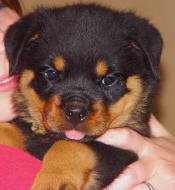 Why
do you want a Rottweiler? Is it because you think they are beautiful dogs?
Because you think they make great protectors? Elegant and graceful? Obedient,
good workers? There are Rottweilers to fit each description and some that fit
all descriptions. The Alleghenies Deutscher Rottweiler
Klub (ADRK) has many members whose interest in the breed has led them to
develop the potential of the Rottweiler for show, obedience, agility, tracking
and Schutzhund. (Schutzhund is a sport involving the guard-dog work, tracking,
extensive obedience, and endurance training). Rottweilers can be trained to do
just about anything as long as they receive consistent training and love from
their owners. Another informative web site with breeder links is
Der- Rottweiler
Why
do you want a Rottweiler? Is it because you think they are beautiful dogs?
Because you think they make great protectors? Elegant and graceful? Obedient,
good workers? There are Rottweilers to fit each description and some that fit
all descriptions. The Alleghenies Deutscher Rottweiler
Klub (ADRK) has many members whose interest in the breed has led them to
develop the potential of the Rottweiler for show, obedience, agility, tracking
and Schutzhund. (Schutzhund is a sport involving the guard-dog work, tracking,
extensive obedience, and endurance training). Rottweilers can be trained to do
just about anything as long as they receive consistent training and love from
their owners. Another informative web site with breeder links is
Der- Rottweiler
Remember that the best dogs are from
healthy, well bred bloodlines and caring, attentive breeders!
Getting What You Pay
For
An indiscriminately bred, 6 week old $150.00 puppy that is advertised
in your local paper is NO BARGAIN. It may have "papers" or be a "purebred" but
it is probable that you will never see a pedigree. It will most likely have
health or temperament problems, not to mention the parents. It could mean big
trouble and expense for you throughout the dog's life. This can be especially
true for hip dysplasia. The replacement of one hip joint can easily cost as much
as a well bred puppy from a reputable breeding program.
The vastly more expensive
puppy from the local pet shop is another possible source of trouble. Along with
the problems listed above, it is more likely to have psychological disorders
brought on from being bred in a puppy mill (a total kennel environment where
puppies are mass produced with no attention to cleanliness, health or
temperament). It will have been separated from its dam and littermates at too
early an age and shipped far too young. Puppies should never be sold younger
than 8 weeks of age.
Buyer
Beware
People who are breeding Rottweilers for the fast buck cannot have an
interest in the welfare of each puppy they sell. It would cost them their
profit. Hobby breeders who do this for the betterment of the breed do so at
their own expense! The dogs sold in pet shops are usually from puppy mills bred
for the marketplace, just like corn or tomatoes. A Rottweiler, is an
emotional being. He needs the care and loving attention of a human
during his formative stages. The bottom line is that there is no substitute for
a dedicated, knowledgeable breeder who is willing to assist you with your
puppy/dog throughout its life.
Buy
Directly from a Breeder
 By
calling, writing or visiting Rottweiler enthusiasts who belong to the ADRK or
their local Rotty club, you will learn where puppies are available and where
there are dogs that excel in qualities that interest you. Check into the
background of the breeder or seller by asking questions. Does she show her dogs
or do obedience? Where are the puppies raised? How are they raised? Are the
dogs health tested? Do the parents have stable temperaments? How much
experience do they have in the breed?
By
calling, writing or visiting Rottweiler enthusiasts who belong to the ADRK or
their local Rotty club, you will learn where puppies are available and where
there are dogs that excel in qualities that interest you. Check into the
background of the breeder or seller by asking questions. Does she show her dogs
or do obedience? Where are the puppies raised? How are they raised? Are the
dogs health tested? Do the parents have stable temperaments? How much
experience do they have in the breed?
Finding
a Reputable Breeder
It is much easier to find a pet shop or a commercial breeder who
advertises in the newspapers than it is to find a good hobby breeder. However,
if you know someone in a local dog club or the ADRK, you can often find a
referral service for Rottweiler breeders. Local vets can usually point you in
the right direction as well. The ADRK lists all breeding that have taken place
involving German studs. A world wide list of Rottweiler breeders can be found at
Der- Rottweiler. Dog
magazines often have ads for litters, especially the magazines devoted entirely
to the Rottweiler, but remember THE PEOPLE WITH THE BIGGEST ADS DO NOT
NECESSARILY HAVE THE BEST DOGS. If there is a dog show in your area, attend and
watch the Rottweilers in both conformation and obedience. Many people will be
glad to answer your questions and inquiries about the breed once they are
finished for the day.
Form
a Relationship
See the parents of the puppy you are inquiring about if possible, and
see other relatives if you can. Quite often the sire will not be on the
premises. Breeders striving for perfection will many times utilize studs owned
out of state, and sometimes out of the country. Ask about the relatives: are
they alive? What are their temperaments like? Spend time with the breeder of
your choice. Dedicated breeders want to place their puppies in the best homes
possible and will do everything in their power to do the right thing for the
puppies on which they have spent so much love, time and money. These breeders
will help you develop the potential of your new puppy. You will get all the
guidance you want from the right person. Do not buy a puppy from someone who
wants to get rid of you once you have paid your money, who does not want to hear
from you about how the pup is doing, brushes you off as a novice, or refuses to
answer your questions. A reputable breeder who has lived with the litter
since its birth knows each puppy's individual personality and tendencies better
than you could learn in a few hours of observation. Be guided by this breeder's
suggestions in making your choice especially in regards to temperament.
Size Does
Matter
There is no point in trying to get a super dog
or, as they have been called by commercial breeders, a Giant, Roman or Oversized
Rottweiler. If you are looking for a dog that is more than 68cm tall, it is
better for you to look to a Great Dane or an Irish Wolfhound. Rottweilers are a
LARGE sized breed, not giant. They were bred to have great stamina, endurance
and agility. An extra large dog loses these important assets.
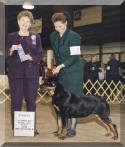 To
Show or Not to Show
To
Show or Not to Show
Most serious breeders of Rottweilers and most members
of the ADRK, ARV, USRC, ARC or other dog clubs are interested in breeding show
dogs. Although it is a bit of an "ego boost" to have bred many Champions, that
is not the reason we breed dogs to show. Each breed of dog has a standard
written by its Parent Breed Club, and responsible breeders will breed dogs which
adhere to these standards. Standards were developed with the original purpose of
each breed in mind.
Showing dogs is a popular
sport around the world. Almost every weekend of the year there are dog shows
across the country. Dog shows give breeders and owners a venue to showcase their
best animals and to demonstrate that their breeding program is helping to
improve the structure and temperament of the breed. Dogs are judged according to
their breed standards, and it is certainly a thrill to be able to say that your
dog is a Champion or Sieger. When your dog wins points towards his title it is a
wonderful feeling.
Maybe an Older
Dog is for You
If you are not prepared to go through the trials and tribulations
of training a baby puppy, an older puppy or even a mature dog can be a wonderful
alternative, especially for households in which the family pet may have to spend
several hours a day unsupervised. A Rottweiler of any age with a good
disposition and temperament can become a member of your family in a very short
span of time.
There are many reasons why
older dogs are available. People's circumstances change and they have to part
with a beloved pet; breeders hold a puppy until it is old enough to determine
whether it was show quality and then decide to sell it; a female has been used
for breeding and her owners are looking for a good place where she can retire;
family divorce. Grown dogs are housebroken, and if well raised they should know
many words and signals, and have some basic obedience training and general
manners. For the working family, they can be perfect!
Another alternative to
adopting an adult dog is to contact rescue groups and committees. These people
take unwanted Rotties, rehabilitate them, and then place the dogs in new homes.
These dogs are usually placed for nominal cost and must be spayed or neutered.
You may also find Rotties in your local pound or shelter, and although these
dogs were abandoned, most are grateful to you for saving them and giving them
the best treatment they have known.
Rescue people will usually
try to help you in every way to acquire a Rotty that will suit your family. Many
thousands of good dogs have been placed in this manner. Rescue can be a very
good source of information and often will try to help solve your pet's
adjustment difficulties, should he have any.
If the older dog has been
well loved and taken care of in its new home, he will give much love and
devotion to his new owner. The key is that A PROPERLY RAISED ROTTWEILER
LOVES AND NEEDS PEOPLE. Never be afraid to take a friendly, outgoing
older animal into your home. Contrary to popular belief, a Rottweiler is not a
one man dog, but adapts well to new family. Although the dog may be confused at
first and cause a few problems, love patience and reassurance will work wonders.
The dog's self-confidence will return and he will settle down.
Try to learn all you can
about the dog you plan to adopt so that you can be certain his temperament is
compatible with yours. Learn as much as possible about his habits, daily
routine, likes and dislikes, diet and past history. It is important that all
family members meet the dog before its adoption and all agree that this is the
dog they want. It is unfair to the dog to adopt him only to give him away a few
weeks or months later. It is wise to acquire the dog when the household member
with primary responsibility for the dog's care and training is at home full time
for the first few days. Time should be made available to make clear to the dog
where he is to sleep, where he is to relieve himself, where he will eat, where
his water dish will be and what he can and cannot do in the house. In short, he
needs to learn the routine he will be following. Wait until you have had him for
a month or so before beginning formal obedience training. This will give the dog
the time he requires to become accustomed to the new environment and to have
confidence in his new owners. Even dogs that have already had some training need
to attend classes with their new owner so that dog and owner can become a
working team.
Dogs with Kids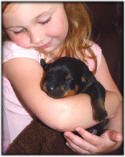
Children and dogs must learn to respect each other from wise parents.
No small child should be left alone with even the smallest dog. Puppies are
quite helpless and children can be cruel. An older dog's defense is to bite,
especially if he is being tormented or teased. Therefore, supervision is
absolutely necessary when children and dogs are together. Some older dogs who
have never had any experiences with kids may be intolerant of a small child's
noise and quick movements. This is particularly true of the adult dominant
Rottweiler. Most dogs of any age, particularly males, consider little people the
equivalent of littermates and will react accordingly. If raised with children,
Rottweilers often "adopt" the child as their own and look out for the child's
welfare. Be cautious though, if this is the case, when your child is wrestling
with neighborhood children, as the dog may become protective of "his" child.
YOUR PUPPY AT HOME
Start Training Early
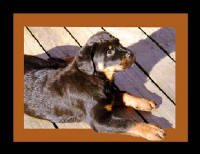 There
are two very important kinds of training you must start when you bring your
puppy home: housebreaking and leash training. A Doberman is eager to learn and
will absorb what you teach him - positively and negatively - from the moment he
enters your life. A Dobe puppy coming to its new home WANTS to learn the rules,
to know its boundaries, and to find out how to keep itself clean. Both
housebreaking and leash training can be accomplished within days if you set up a
schedule and adhere to it. Patience and consistency are the watchwords! Several
books will tell you about training your puppy, but a few helpful hints are
below.
There
are two very important kinds of training you must start when you bring your
puppy home: housebreaking and leash training. A Doberman is eager to learn and
will absorb what you teach him - positively and negatively - from the moment he
enters your life. A Dobe puppy coming to its new home WANTS to learn the rules,
to know its boundaries, and to find out how to keep itself clean. Both
housebreaking and leash training can be accomplished within days if you set up a
schedule and adhere to it. Patience and consistency are the watchwords! Several
books will tell you about training your puppy, but a few helpful hints are
below.
Housetraining
Puppies have to relieve themselves almost immediately after walking,
eating, sleeping, after playing, and sometimes in the middle of playing. It is
best to bring your puppy home when you can arrange to be with him for at least a
week to observe and attend to his needs. When you wake up in the morning, plan
on putting a coat over your nightclothes and walking your puppy. Do not wait to
get dressed because the puppy will not. He will soon show you his signal if he
is housebroken and you will pick it up easily. NEVER strike your puppy
or insult his dignity by "rubbing his nose in it." PRAISE HIM
EXTRAVAGANTLY WHEN HE DOES SOMETHING RIGHT! Ignore mistakes - they are
probably yours in most cases. Rewards for good behavior work wonders.
The Vari-Kennel
One of the greatest inventions for house training a puppy is the crate
or kennel. (It is also the safest way to travel with your dog). There are many
kinds and models and they are illustrated in many dog magazines. The best crates
are made of washable, molded plastic that the puppy cannot chew. They come in
various sizes and you should get the large (400) or extra large (500) for your
Rottweiler.
The crate satisfies the dog's
natural instinct as a den animal, which is to sleep in some sort of hole WHICH
IT WILL NOT SOIL. When a puppy crawls into its favorite spot to sleep it is
usually under the end table or behind a chair where it instinctively is
protected on all sides. By providing a crate of its own for your pup, you are
catering to its own tendencies while making positive strides toward future
training. Put a comfortable, washable cheap rug or blanket in the kennel with a
harmless toy. Place the crate somewhere near where you spend a great deal of
time or near where you sleep (or move from one to the other) so the pup does not
feel too lonely. Be sure there is a clear path to the door so you can get the
puppy there without an accident when he wakes up from his snooze. Best is to
actually carry your puppy from his crate to the location you would prefer the he
relieve himself.
Your puppy will become
accustomed to his kennel in no time. Give him a treat when you put him in
there and NEVER use it to punish him. It is the safest place for him when
you are unable to supervise or when you are away from home. If you take him out
in the car, he will be safe from sudden stops and quick escapes if he is in the
crate. The advantages of investing in a crate are enormous: the puppy will get
the sleep he needs (and puppies need a lot), he will not soil his bed if he can
help it. Your puppy will learn there is a place that is ALL his to retire to
when he wants. When your puppy is a grown dog and fully civilized, the door can
be left open or taken off, and he will use it as his own private space all his
life. Of course, no puppy should spend more than a few hours at a time confined
to a crate. Puppies need time to exercise, to develop growing bones and muscles,
and to improve coordination.
Leash Training
It is never too early to start your puppy's training. Take the puppy
outside away from a play area, and put a light leash and collar on him. Start
out with a soft nylon buckle collar. I personally do not recommend 'choke'
collars for training. The pop and jerk method of training has come and gone, and
this action can do irreparable damage to your dog's (especially a young dog's)
neck and spine. If training is done regularly and consistently with oodles of
praise and positive reinforcement, there should be no reason to use a choke
chain.
At first, let the puppy run
about by himself for the first few trips. Because a puppy's attention span is
very short, several short sessions each day are better than one long one. Five
minutes twice a day is a good start. After about three or four times of getting
the puppy used to having the collar and leash attached to him, gently pick up
your end of it and follow him around. After you have done this a few times,
start getting him to come along the way you want to go. DO NOT DRAG THE PUPPY!
Make him come with you by using your voice in a fun manner, and by coaxing him
with cookies or toys if necessary. You will be amazed at the progress made in
just a few days. Of course, you will praise and hug the little darling every
time he does something right, so that he knows he has pleased you! NEVER LEAVE A
CHOKE COLLAR on any puppy or dog when the dog is unattended or playing. It is
too easy for a dog to get strangled or choked. Instead, if you must keep a
collar on the pup, use a soft leather or nylon buckle collar, complete with his
identification tags.
Puppies can be
Destructive
All puppies are destructive if given the opportunity but Rottweiler
puppies, because of their tremendous energy, seem to be able to find more things
to mangle and destroy than most others. Even a grown dog left alone in the
house, bored and lonely, will surprise you with his selectiveness in this
department. Do you have a favorite chair? He will shred it. Your new mink,
tossed onto the sofa is just another dead animal to him: your favorite books are
gristle to his milling jaws. THE CRATE TAKES CARE OF THIS PROBLEM! Just picture
these two situations:
-
You come home and find that
even though you have given baby the freedom of only one room, he has gotten
out of it and has visited your bathroom where he has unrolled the paper all
over your living room and then taken a pillow off of your sofa and made snow
all over the floor. In the middle of the carpet, there are several puddles and
a pile. You begin to scream, and that, combined with your body language, is
enough to convince the poor pup that he should be concerned and not happy when
you come home. He is truly not aware that he has done wrong because you did
not catch him in the act of destruction. Inevitably, he associates your
coming home and being angry with seeing him, and he becomes a shivering and
slinking puppy every time you walk through the door. BAD SCENE!
-
Now think about coming home
from your errand eager to see the little dear. He is snoozing in his crate and
he hears your key turn in the door. He thinks, "Oh Boy" the boss is home!"
When you open the crate door he is thrilled to see you and immediately wants
to go outside. You take him for a walk outdoors where he relieves himself and
you both play happily for a while. This is positive training at its peak!
CARE AND FEEDING
For Your Dog's Health
Not all vets are created equal.
If this is your first dog, it
will be extremely helpful for you to shop around for a vet as carefully as you
have for your dog. Ask your breeder if she knows of a good vet in your area.
If you live in a large city, you will have more to chose from, but the vet
closest to you may not be the best choice. It is better to have to drive 30
minutes to a GREAT vet than walk across the street to a BAD vet. In selecting a
vet, look for someone you can talk to, and who will also listen to you. What are
his hours? What facilities does he have? What sort of assistants are on the
staff? How much does he know about Rottweilers? Is he willing to give you his
home phone number for emergencies? Examine your vet's hospital as you would
choose one for yourself. Someday your dog's life may depend on the efficiency,
knowledge and talent of your vet and his crew.
Start your relationship with
your vet with the idea that your dog is extremely valuable to you and you want
his doctor to view him in that light. Have your dog thoroughly checked over
within a few days of acquiring him. Even the most careful breeders sometimes
sell a puppy with worms. Show your vet the information you have received from
the breeder, and ask him to follow the recommendations for vaccinations.
Expectations of
the Seller
When you purchase your dog or puppy from a
reputable breeder or owner, it should come to you accompanied by
registration papers, as well as recommendations covering care and feeding. You
should also be provided with a written health record. Some breeders may also
give you several days' supply of the dog's current diet as well as a toy,
blanket, towel or other object to which your dog has become accustomed. If no
toy came with him, give him something he can keep as his very own, as long as it
is completely harmless. Remove the eyes from any stuffed animals. REMEMBER,
PUPPIES WILL SWALLOW ANYTHING!
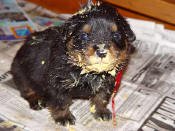 Feeding
It is a basic fact of canine nutrition that
puppies need a very high quality food, but unfortunately, and despite all the
advertising, the best quality food does not come from a bag. It is best for
large breed puppies to grow slowly, giving their joints time to adjust and grow
properly. Ask the breeder what your pup has been eating and follow their
instructions. If you are unable to continue that food, or if you are
going to switch to something else, consult with your breeder first.
You will have to increase the
volume of your dog's food as he grows. A 9 week old puppy may eat three times a
day and then will start to reject portions or all of a meal (probably by the
time he is 4 months old). That is when you should cut down to two meals per day,
equal in volume to the amount fed in three meals. As he grows older, you may
have to make his meals larger or smaller, depending upon his condition. Once the
dog turns a year old, some people switch to feeding their dogs once a day, but
two meals a day all the dog's life is better. Rottweilers are usually avid
eaters and will overstuff if you are not careful, so do not free feed your dog
by keeping his dish full all the time. If your dog does not gorge himself, the
opposite is likely, and he will become a finicky eater. For dogs that seem
perpetually hungry, two meals a day is much more satisfying. It also reduces the
risk of bloat or torsion. It helps the dog feel full and reduces the risk of
excessive chewing and other forms of destruction.
Watch your dog's weight and
feed him accordingly. Keep to a relatively loose schedule or your dog will
expect to be fed at a certain time each day and will begin to demand the same.
Keep Your Yard
Clean
Pick up the stools every day from your yard and
any surrounding territory. "Pooper-scoopers" are found at all pet stores, and
will become your most used item. Plastic bags or newspaper can be used to wrap
the package neatly and bestow it with other garbage. Cement runs and gravel
areas, after being picked clean of stool, should be washed twice a week with a
solution of 3/4 cup bleach or 1/4 cup of orange TKO to one gallon of water.
Keeping your outside areas clean helps to keep your house clean and pet healthy.
home
males
females
puppies
young dogs
for sale
health
news
importing
links